Description
**Description**
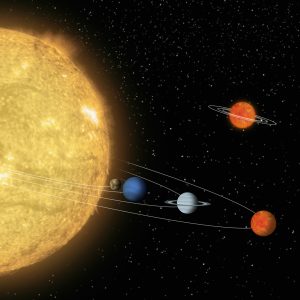
This advanced training programme places you at the frontier of one of the most exciting fields in contemporary science: the search for worlds beyond our Solar System and the possibility that some of them may harbour life. You will begin with a historical module tracing the path from the first confirmed exoplanet detection around a pulsar in 1992 and the first detection around a main sequence star in 1995, through to the current catalogue of over five thousand confirmed exoplanets — understanding how detection rates accelerated and what drove that acceleration. The training devotes a full module to the transit detection method — the technique behind the Kepler and TESS space telescopes — explaining the geometry of planetary transits, what a transit light curve reveals about planet size, orbital period, and atmospheric composition, and how false positives are identified and filtered from genuine detections. You will study the radial velocity method in equal depth, learning how a planet’s gravitational tug creates Doppler shifts in its host star’s spectrum, how precision spectrographs like HARPS and ESPRESSO achieve the sensitivity to detect Earth-mass planets, and how combining radial velocity with transit data yields planetary density and therefore bulk composition. The training covers direct imaging of exoplanets — one of the most technically demanding observational achievements in modern astronomy — including the coronagraph and starshade technologies that suppress overwhelming stellar glare, and which exoplanets have been directly imaged to date. You will receive a downloadable exoplanet comparison database covering fifty scientifically significant confirmed exoplanets, organised by detection method, host star type, planetary radius, mass, orbital period, equilibrium temperature, and habitability assessment — a research-quality reference document. A dedicated module on planetary habitability goes well beyond the simplistic concept of the habitable zone, examining atmospheric composition and greenhouse effect, magnetic field protection, tidal locking implications for climate, stellar activity and UV radiation exposure, and the role of planetary geology in sustaining surface liquid water over geological timescales. The training introduces transmission spectroscopy — the technique used by the James Webb Space Telescope to analyse exoplanet atmospheres — and explains what specific molecular signatures, including water vapour, carbon dioxide, methane, oxygen, and ozone, would constitute evidence of biological versus abiotic chemistry. You will study the most promising potentially habitable exoplanet systems in detail: the TRAPPIST-1 system of seven rocky planets, Proxima Centauri b, the K2-18 system with its possible hycean world, and LHS 1140 b — evaluating the evidence for and against habitability in each case. A module on astrobiology grounds the search for extraterrestrial life in the science of life’s origin and limits on Earth, covering extremophiles, the RNA world hypothesis, panspermia, and the Drake Equation as a framework for estimating the prevalence of intelligent life. The training concludes with a forward-looking module on the next generation of instruments — the Extremely Large Telescope, the Habitable Worlds Observatory, and the LIFE mission concept — and what each could reveal about nearby potentially inhabited worlds within the next two decades.
**Format**
Advanced video training with a downloadable exoplanet comparison database, JWST spectroscopy guide, and a curated research paper reading list.
**Duration**
5 hours of advanced training content across 12 modules, with a 50-entry exoplanet reference database.
**What You’ll Learn**
Exoplanet detection methods; transit and radial velocity analysis; direct imaging; planetary habitability science; transmission spectroscopy and biosignatures; TRAPPIST-1 and key systems; astrobiology foundations; future telescope capabilities.
**Target Audience**
Advanced astronomy students, science graduates, astrobiology enthusiasts, and educators or science communicators who need a rigorous and current grounding in exoplanet science and the search for life beyond Earth.